
Deterministic Governance
A structured alternative to subjective programme reporting — focused on repeatable posture, lifecycle discipline, and executive clarity.
Programme governance reporting is widely practised but structurally inconsistent. Most organisations rely on Red, Amber, and Green indicators supported by narrative explanation. While intuitive, this approach introduces variability. Colour definitions drift between teams. Gate criteria are interpreted differently. Posture becomes influenced by context rather than consistent structure.
The consequence is gradual erosion of clarity. Executives interpret tone rather than structure. Escalation occurs later than it should. Comparability across projects becomes unreliable. The issue is not absence of information. It is absence of structured interpretation.
Deterministic Governance reframes posture as the outcome of defined evaluation. Instead of assigning colour subjectively, teams maintain structured governance signals across explicit domains. These signals are evaluated through transparent rules. Equivalent inputs produce equivalent conclusions.
- Structured signal domains
- Explicit posture mapping logic
- Immutable governance snapshots
- Stage-aware lifecycle enforcement
When posture is deterministic, drift becomes visible, gate discipline strengthens, escalation occurs earlier, and executive confidence increases. Governance becomes deliberate rather than performative.
Deterministic Governance does not remove professional judgement. It constrains ambiguity. When equivalent conditions produce equivalent conclusions, posture becomes dependable. Dependability builds trust. Trust strengthens oversight.
PACT implements this model as a structured governance platform, designed to enforce repeatability across projects, programmes, and portfolios.
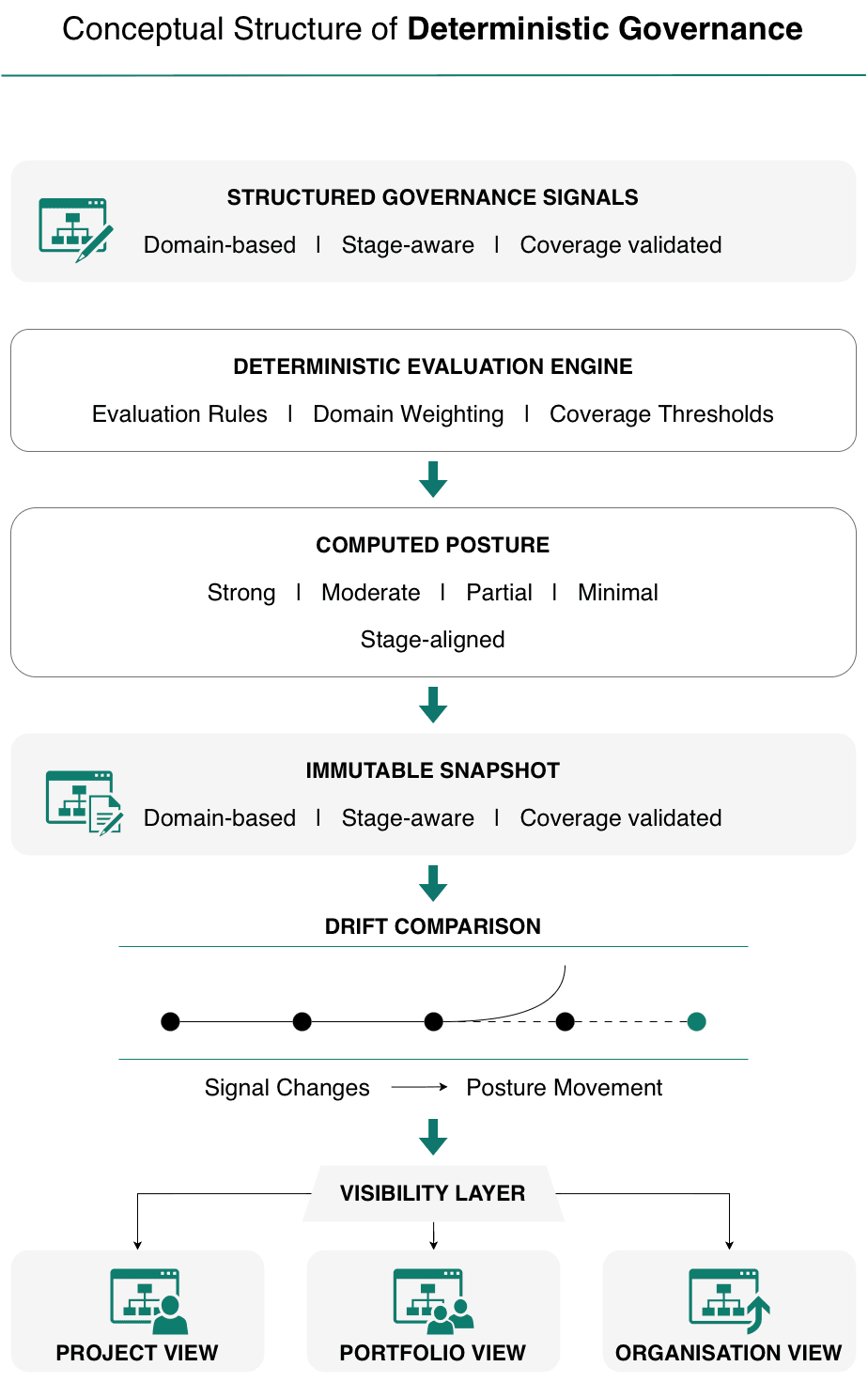
Figure 1. Conceptual structure of Deterministic Governance. Structured signals are evaluated through explicit rules to produce a repeatable posture, recorded as an immutable snapshot and compared over time for drift. Visibility scales from project to portfolio without reinterpretation.
1. The Structural Problem in Programme Reporting
Governance reporting has evolved pragmatically rather than architecturally. Tools have improved. Dashboards have multiplied. Reporting cadence has accelerated. Yet the underlying determination of posture remains largely interpretive.
1.1 RAG Drift
Red, Amber, and Green are intuitive. Their strength lies in simplicity. Their weakness lies there as well. Two project managers assessing identical delivery conditions may reasonably assign different colours. Over time, differences accumulate; definitions stretch; meaning shifts. Executives are left interpreting tone rather than evaluating structure.
1.2 Gate Ambiguity
Stage gates are intended to introduce discipline. In practice, criteria are often loosely defined. Without explicit signal definitions and evaluation rules, gate decisions rely on persuasion as much as proof. Governance maturity varies between teams within the same programme.
1.3 Reporting as Performance
Where posture is subjective and gate criteria flexible, reporting becomes performative. Escalation occurs later than it should. Intervention becomes reactive. The issue is not dishonesty. It is structural ambiguity.
2. The Deterministic Alternative
Deterministic Governance reframes posture as the outcome of structured evaluation rather than narrative interpretation. Equivalent inputs must produce equivalent outputs.
2.1 Structured Signals
Posture derives from explicit signal domains assessed through structured questions rather than open narrative commentary. Judgement remains, but it is anchored to defined signal definitions.
2.2 Deterministic Posture Mapping
Given defined signals and coverage thresholds, posture is computed using explicit rules. Critical weaknesses can constrain posture. Coverage shortfalls are made visible rather than inferred.
2.3 Immutable Position Snapshots
Each snapshot captures signal state, coverage, constraints, and computed posture at a point in time. This enables comparison without reinterpretation.
2.4 Lifecycle Awareness
Governance posture is stage-aware. Concept, Design, Build, Release, and Operate each have different evidence expectations. Progression should be evidence-based rather than calendar-driven.
3. Drift Detection and Cadence Reporting
Deterministic snapshots support structured comparison. When posture changes, underlying signal differences are visible. Cadence reporting becomes clearer and less negotiable.
4. Governance Scope
The model operates at multiple levels. At project level, posture clarity supports disciplined self-assessment. At programme level, consistency enables meaningful comparison. At portfolio level, aggregation becomes possible without normalising reporting style.
5. Cultural Implications
Deterministic Governance relocates judgement. Debate moves from colour assignment to signal accuracy. Escalation becomes earlier and clearer. Over time, governance becomes less performative and more disciplined.
6. Implementation Considerations
Introducing a deterministic model is structural rather than organisational reinvention. It requires signal clarity, stage alignment, coverage discipline, and cadence stability. Technology enables enforcement, but structure remains primary.
- Define governance signal domains and keep them stable over time.
- Align signal expectations to lifecycle stages to avoid misapplied criteria.
- Set minimum coverage thresholds and make coverage visible.
- Record posture on a deliberate cadence (weekly/fortnightly) to reduce narrative drift.
Closing reflection
Governance reporting does not fail because of poor intent. It falters because interpretation is allowed to drift. A deterministic model offers repeatability. When equivalent conditions lead to equivalent conclusions, posture becomes dependable. Dependability builds trust. Trust strengthens oversight.
PACT implements the Deterministic Governance model as a stage-aware assurance platform for projects, programmes, and portfolios.